

How To Repair A Floating Panel
Entry doors are expensive and are frequently fitted to the exact door opening, making replacement more challenging. Peculiarly when it comes to older and specialty doors, repair makes a lot of sense. We perform all types of door repairs. Here are a couple that we regularly encounter.
Door Anatomy Lesson
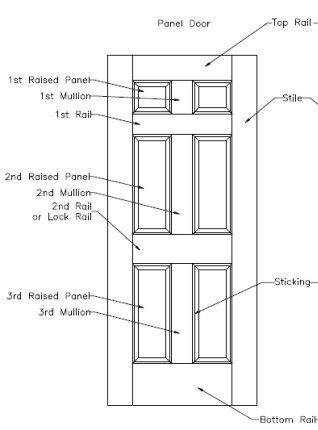
The anatomy of a traditional half-dozen-panel door, source: https://brownstonecyclone.com/
An entry door is usually constructed with cope and stick joinery, significant that the profiled portions of the door that resemble mouldings, are cut into the structural members of the door. When the mouldings are cut into the edges of the door, they're known as sticking.
The structural members, the stiles (vertical parts) and rails (horizontal parts) are fitted to each other with a mortise and tenon joint. These joints are intended to be permanent and ordinarily last for hundreds of years. In betwixt the stiles and rails are floating panels, pregnant that the panels are not glued in place, allowing the door to expand and contract without cracking the panels. The panels are generally a glue-up of alternating grained pine or similar. These panels are "raised" or cutting with a tapering edge profile around their perimeter. This allows them to fit into a "dado" or groove around the inside perimeter of the door. This is commonly referred to as frame and panel construction and is ane of the foundations of traditional woodwork.
Panel Damage

cracked panel (via pinterest)
We run into 2 main types of damage on these types of doors—i caused by overzealous painting and another crusade by forced entry. Sometimes a well-intentioned painter goes the extra mile and caulks the panel to the sticking so that at that place's no gap. It looks great for a while, but it causes bug inside 1-5 years. What this does is binds the panels to the sticking and can actually cause the console to be pulled autonomously, ripped clean in two! This usually ways cutting the caulk and scraping the entire panel with a card scraper then gluing and endmost the joint back together and re-painting.

console kicked in by firemen during a rescue operation
We also sometimes encounter firemen force their fashion in through a door console since it's the thinnest part of the door. This commonly means complete replacement of the panel and i side of sticking. This is a fairly complicated repair. Information technology requires gluing up a panel, raising the panel, milling new sticking, removing the remnants of the one-time sticking, gluing the new panel moulding in place, sanding, priming, painting, etc. That's over a half twenty-four hour period repair without paint. Merely, when the culling is replacing the original entry door, it makes sense.
Jamb Issues
The door slab itself is only as practiced as its jamb. I see more issues with jambs that doors! Hither are a few of the primary ones:
The lock set doesn't strike at the strike plate
Many of the neighborhoods nosotros work in such every bit Park Hill, Mayfair, University Hills, and Cory-Merrill, were built in the 1920's-1940'south. These homes often originally had mortise locks, a lock style that is essentially a metallic box full of levers and springs that'due south buried several inches inside the door. Modern locksets are barrel-style or cylindrical. When homeowners want to proceed the original door only use a modern lock, it normally means filling the old mortise and re-boring.

Door is repaired and ready for sanding and paint
There are few finer points to a repair like this. First, it'southward important to match the species of forest and wet content ideally. I salvage old growth pine from erstwhile doors to use to fill these mortises because its density and moisture content will be nearly identical to the original. That means it will move with the door at the same charge per unit throughout the seasons and will take paint beautifully and never flash through. I cutting a long-grain cake to fill the mortise, epoxy information technology in place and plane it affluent when the epoxy cures.
For the face bores, this is where I see well-nigh guys mess upwardly because they don't pay attending to grain orientation. You have to cutting a face-grain plug from the same species rather than jamming an cease-grain dowel into the pigsty and cutting it off. End grain doesn't take finish or glue in the same manner equally face grain and information technology'south also a pain to plane flush. By paying attention to grain orientation, you tin can make a perfect repair that will await factory fresh!
Joinery Failure
It's rare, simply sometimes the bodily joinery of a door fails. This is unremarkably due to a number of factors going wrong all at one time. When this happens, if it's a stock door that can be replaced with something off-the-shelf, it makes sense to scrap the former door and supervene upon it. When it's something unique though, we an repair it with some time and endeavor.

the crest rail and stile were pulling autonomously
Nosotros fixed a gate this yr that had failed completely due to improper joinery. The builder used dowels to join the stiles and rails, which is fine, but the dowels were nether-sized, just 1/4" dowels for this one-i/2" thick gate! They used standard forest glue which is non waterproof. They also oriented the grain of the wood in such equally way as to allow the door'southward natural expansion and contraction to force the joints apart by placing the crest rail on superlative of the stiles, rather than in between them. The final trouble I found was they they hadn't pre-finished the floating panels, so the portions that were dadoed into the door were exposed to the elements and when the panel shrunk during the winter, there was a light-colored border of unfinished wood exposed to the winter elements. It was a perfect storm, so to speak, for weather damage.
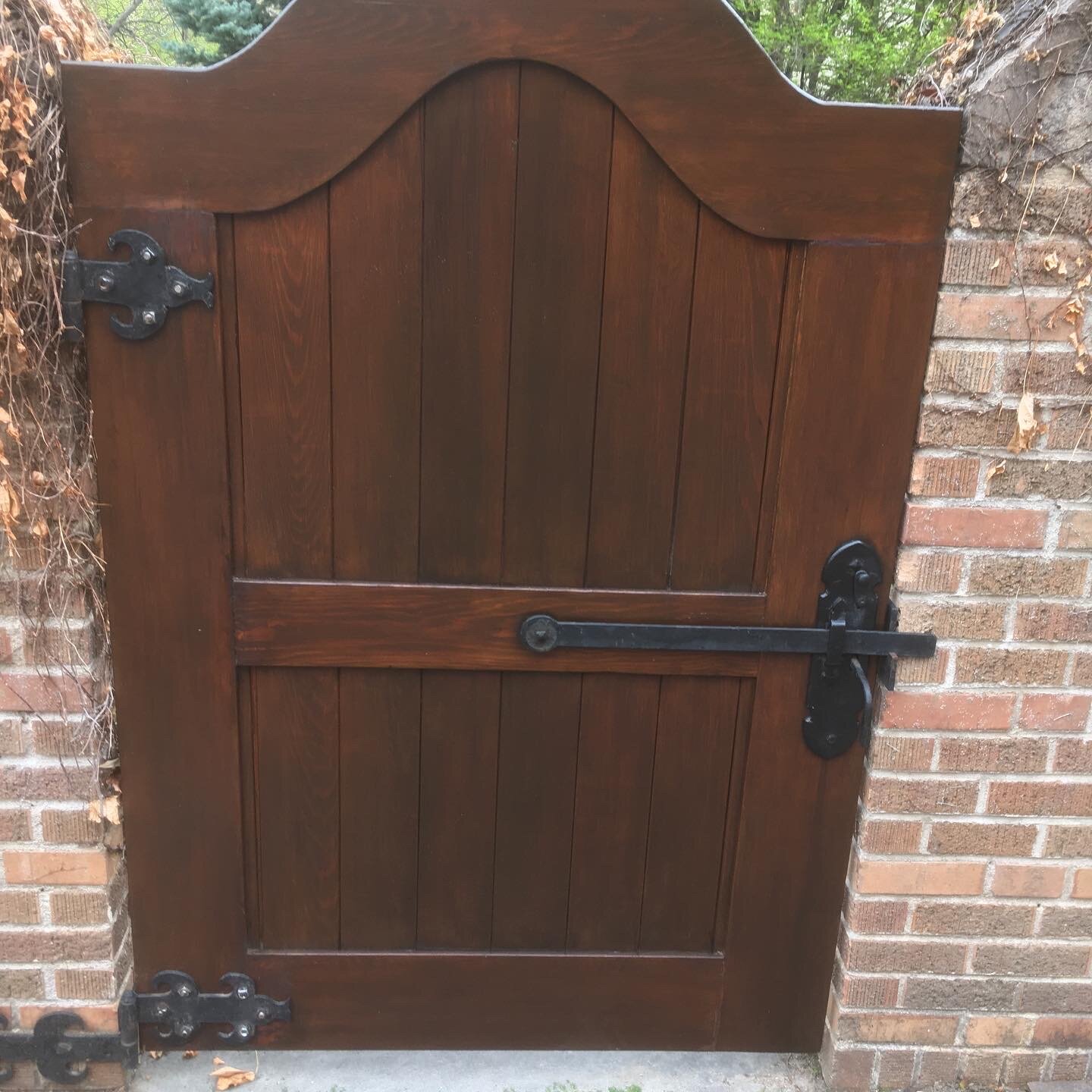
The repaired gate, set for many more years of service
Nosotros disassembled the gate completely and sawed off the old dowels, replacing them with i/2" dowels, 4 inches long. Everything was reassembled with a polyurethane adhesive which is weatherproof and super strong. Next, the floating panels were pre-finished effectually the perimeter to prevent further harm. While nosotros couldn't re-construct the crest rails, we added long timber-lock lags subconscious nether a tapered face-grain plug. The cease effect was a gap-complimentary door set up for several more years of service.
Replacing an onetime lock with a newer style

This door had a mortise lock iv hours earlier. We filled the sometime lockset and installed this new baldwin entry lock
This is 1 of the most common gripes with locksets in general. The plate where the lock wants to latch is either too high, too low, to far inside, or also far outside. Sometimes information technology'due south as piece of cake equally adjusting the latch adjuster, a tab on the inside of the strike plate, with a flat bladed screwdriver. Other times, it means tightening a swivel screw into either the door or the jamb (the door is sagging), or moving the strike plate position. I apply what's called a "witness mark" to locate the strike, by blackening the latch with graphite and rubbing it against the jamb. The old position tin can exist patched with a wooden cake known every bit a "dutchman", planed flat, so the strike tin can be re-mortised and bored.
Sometimes, the issue is weatherstripping. This is actually a good problem to have, since your weatherstripping needs to be compressed to do its chore. Depending on the blazon of weatherstripping you have, it could require more than than a gentle nudge to go the door to latch. This can mean fine-tuning the strike or swapping the weatherstripping for a thinner variant. We use top-quality silicone weatherstripping from Conservation Technologies on our projects, or traditional 5-bronze.
"Are your doors in a jam and in need of some dearest? Are yous unhung doors in need of a jamb? Are y'all sweeps binding, strikes missing, hinges creaking, stiles outdated? We're your Denver door repair experts. "

Source: https://www.cougilldiversified.com/blog-1/2020/6/26/door-repair-a-few-common-problems-and-their-solutions
Posted by: oliphantsperoar.blogspot.com
0 Response to "How To Repair A Floating Panel"
Post a Comment